A Journey Through the Planets
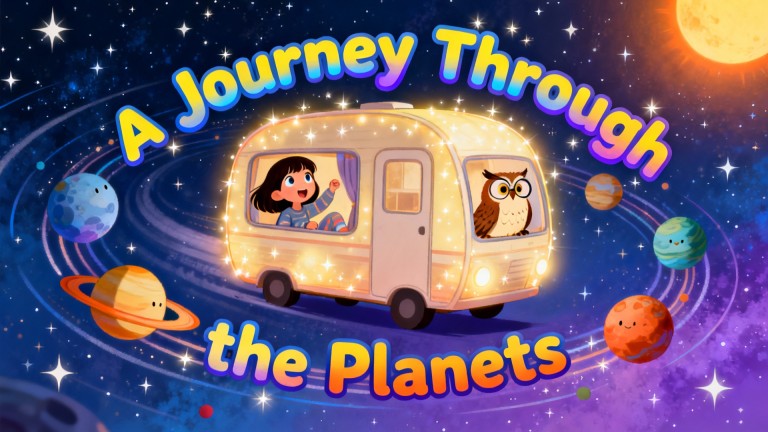
A young girl takes a magical trip through the solar system to learn about the planets.
- Recommended age
- 5-7
- Theme
- Science
- Length
- 20 story pages
Page 1
A young girl takes a magical trip through the solar system to learn about the planets.
Page 2
Once, a curious girl named Ava lived in a town by a river. She loved looking at the stars and planets. One night, as she lay in her backyard, something magical happened.
Page 3
Ava saw a glowing light and started to float. She found herself in a magical caravan with friendly creatures. 'Welcome, Ava!' said a wise owl named Galileo. 'We're going to explore the planets!' 'Wow!' Ava said excitedly.
Page 4
They flew to Mercury. 'It's the closest planet to the Sun,' said Galileo. 'It's small and rocky. Hot by day, cold at night.' Ava saw the gray, bumpy planet. 'It looks like a giant, bumpy ball!' she laughed.
Page 5
Mercury is the closest planet to the Sun. It's small and rocky. It's very hot in the day and very cold at night. It has many craters, so it looks like a big, bumpy ball.
Page 6
They went to Venus. 'Venus is the hottest planet,' said Galileo. 'Its thick air traps heat. It even rains acid!' Ava wrinkled her nose. 'It must be hard to live there!' she said.
Page 7
Venus is the hottest planet. Its thick air traps heat. The air has acid clouds, and it rains acid. It's a harsh place.
Page 8
They reached Earth. 'This is our home,' said Galileo. 'Earth has water, air, and is just the right distance from the Sun. That's why it has life.' 'Earth is so beautiful,' said Ava.
Page 9
Earth is the only planet we know with life. It has water and air, and it's the right distance from the Sun. From space, Earth looks beautiful with clouds and oceans.
Page 10
They went to Mars, the Red Planet. 'Mars has the tallest volcano and deepest canyon,' said Galileo. 'Scientists think it may have had water long ago.' 'Maybe people will live there someday!' Ava said.
Page 11
Mars is called the Red Planet. It has the tallest volcano and deepest canyon in the solar system. Scientists think Mars may have had water long ago, so maybe it had life.
Page 12
They flew to Jupiter. 'Jupiter is the largest planet,' said Galileo. 'It has a big storm called the Great Red Spot!' 'It looks like a giant marble!' Ava marveled.
Page 13
Jupiter is the largest planet. It is a gas giant made of gases. It has a Great Red Spot, a storm bigger than Earth! Its colors swirl like a giant marble.
Page 14
They moved on to Saturn. 'Saturn's rings are made of ice and rock,' explained Galileo. 'It's another gas giant.' 'They're so beautiful!' Ava admired.
Page 15
Saturn is known for its rings made of ice and rock. Like Jupiter, it is a gas giant. The rings are delicate and make Saturn easy to recognize.
Page 16
Next was Uranus. 'Uranus rotates on its side,' Galileo pointed out. 'It's an ice giant with a blue-green color.' Ava giggled. 'It looks like a tilted, sleepy planet!'
Page 17
Uranus rotates on its side, unlike any other planet. It is an ice giant with a blue-green color because of methane gas in its atmosphere.
Page 18
They reached Neptune. 'Neptune is the windiest planet,' said Galileo. 'It's an ice giant with strong storms.' Ava was fascinated. 'It's like a stormy ocean in space!'
Page 19
Neptune is the windiest planet. It is an ice giant with a deep blue color because of methane gas. Neptune has powerful storms, like a stormy ocean in space.
Page 20
Time to go home. 'What do you think, Ava?' asked Galileo. 'I loved it!' Ava exclaimed. Back in her backyard, she watched the caravan disappear. She shared her adventure with friends, inspiring them to look at the night sky with wonder.