Nine Nights, Nine Little Questions
Join Anaya through Navratri as Aaji answers her little questions about diyas, garba, courage, kindness, sharing, truth, and the strength to grow brighter inside.
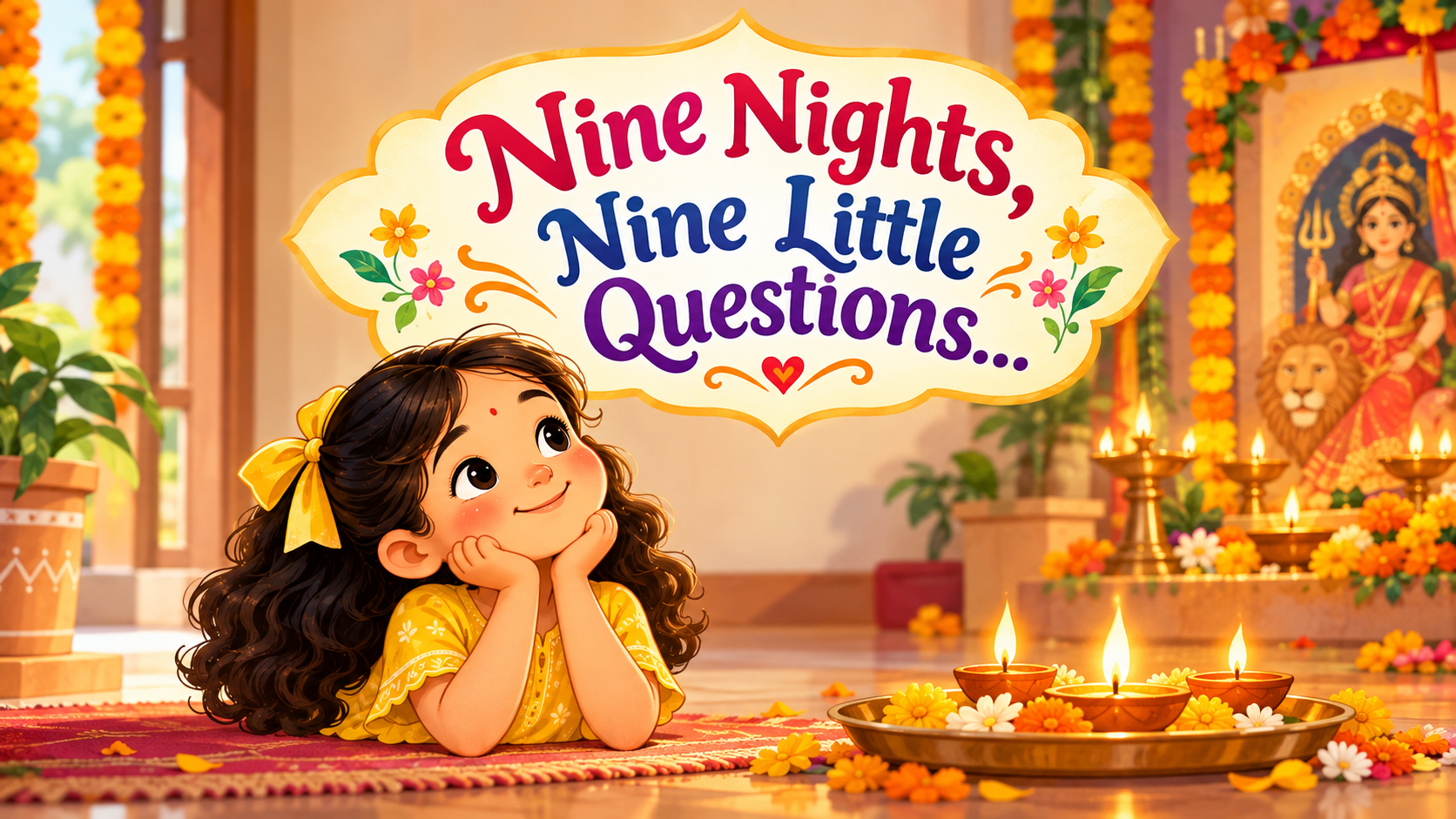
Anaya loves Navratri, but this year she has many little questions. Across nine nights, Aaji helps her understand the meaning behind diyas, dancing in a circle, Maa Durga’s strength, fasting, kindness, and bravery. Through simple moments at home, school, and with friends, Anaya learns that festivals are not only about flowers, sweets, and celebration, but also about becoming kinder, more truthful, more helpful, and more courageous inside.
Anaya loved Navratri. The festival filled her home with colorful flowers at the door, twinkling diyas near Maa Durga, the sound of dandiya sticks, and the delicious smell of prasad from the kitchen. But this year, Anaya had questions.
On the first night, Aaji lit a small diya. 'Aaji,' Anaya asked, 'why do we light a diya?' Aaji smiled gently. 'Because even a small light can remove darkness,' she explained.
The next day, Anaya helped her little brother find his toy under the bed with a torch. 'See,' she said proudly, 'a little light helped.'
On the second night, Anaya watched everyone dance garba in a circle. 'Aaji, why do we dance round and round?' Anaya asked. 'In a circle, no one is first and no one is last. Everyone belongs,' Aaji said.
Anaya noticed a new girl standing quietly at the gate. 'Come,' Anaya invited, 'you can stand next to me.' The girl smiled and joined the circle, feeling welcome.
On the third night, Anaya looked at Maa Durga's picture. 'Aaji, why does Maa Durga have so many arms?' 'To remind us that strength can do many things,' Aaji explained. 'It can protect, help, bless, and stand against wrong.'
'I have only two,' she said. Aaji laughed. 'Two are enough if they are used well.' Anaya used her two hands to help Amma fold clothes, pick up flowers, and share her crayons with her brother, showing that even two hands can do much.
On the fourth night, Anaya wore a yellow ribbon. 'What does yellow mean?' she asked. 'Joy and kindness,' Aaji replied with a twinkle.
At school, Anaya's friend forgot her tiffin. Anaya broke her paratha in two. 'One for you, one for me,' she said, making her friend smile brightly.
On the fifth night, Anaya saw Amma eating simple food. 'Why do some people fast?' she asked. Aaji said, 'Fasting teaches us to control our wants.'
That evening, Anaya saw her brother eyeing the biggest laddoo. She shared it with him, realizing that sharing made it even sweeter.
The sixth night, Anaya helped her friend Riya remember the garba steps. 'Step, clap, turn,' she whispered, and they both laughed at their mistakes. As Aaji said, 'Strength can help.'
A strong wind blew on the seventh night, and one diya went out. Anaya quickly covered the remaining diyas with her hands. 'Aaji!' she called, and together they protected the light.
'Can children also be brave?' Anaya asked on the eighth night. 'Of course,' Aaji said. 'Children are brave when they tell the truth, say sorry, try again, or help someone.'
Anaya remembered the torn page in her library book. She took it to her teacher and said, 'I am sorry. I tore this page by mistake.' Her heart felt lighter.
On the ninth night, Anaya asked, 'Aaji, what does Navratri really mean?' 'Navratri means remembering the strength inside us,' Aaji explained. 'The strength to be kind, truthful, helpful, and to try again.'
On the tenth morning, Anaya wore her yellow ribbon again. Amma asked, 'What colour are you wearing today?' 'Today, I am wearing kindness, courage, and one big smile,' she said.
And that Navratri, Anaya understood , Festivals are not only for new clothes, sweets, and dancing, but becoming a little brighter inside. Moral: Navratri reminds us that true strength is found in kindness, courage, patience, truth, and love.